

Research
Mechanism of Inhibition Alleviation and Performance Enhancement by Fe₃O₄ Nanoparticles in Anaerobic Digestion of High-Concentration Organic Wastewater
Recently, the Team of Pollution Treatment of Rural Living Environments at the Biogas Institute of Ministry of Agriculture and Rural Affairs investigated the use of Fe₃O₄ nanoparticles (Fe₃O₄ NPs) to enhance the anaerobic digestion performance of high-strength synthetic wastewater. The study elucidated the mechanisms by which Fe₃O₄ NPs alleviate inhibition and improve digestion efficiency. The findings were published in Biomass and Bioenergy.
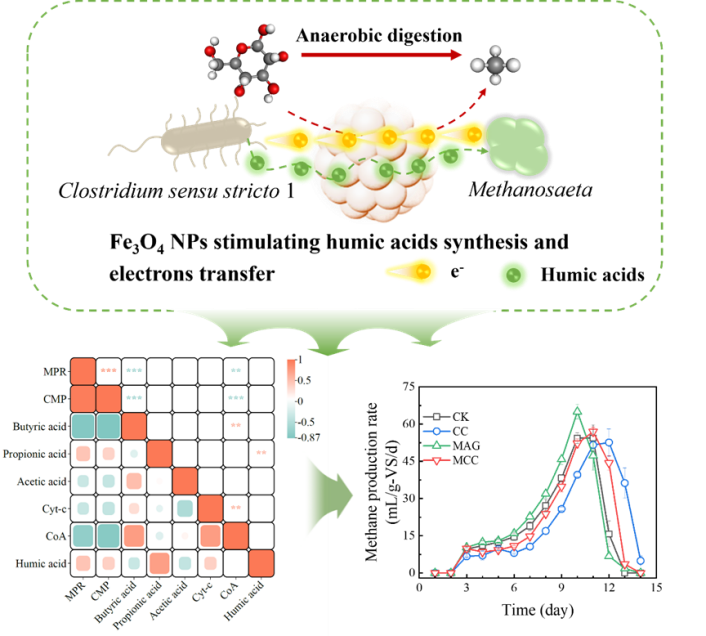
To address the common issue of acidification during anaerobic digestion of high-concentration organic wastewater, this study introduced Fe₃O₄ NPs to enhance methanogenic fermentation performance. The results showed that the addition of Fe₃O₄ NPs increased the maximum methane production rate by 19.6% and significantly mitigated the inhibitory effect of hydrophobic carbon cloth on methanogenesis. The maximum methane production rate in the Fe₃O₄ NP-amended system was 1.6 times that of the hydrophobic carbon cloth group.
Mechanistically, Fe₃O₄ NPs improved methanogenesis by reducing microbial synthesis of c-type cytochromes, promoting humic substance formation, enriching microbial communities involved in interspecies electron transfer, and enhancing carbohydrate degradation pathways. These combined effects accelerated the conversion of volatile fatty acids into methane.
This study provides important theoretical support and technical direction for strengthening anaerobic digestion of high-strength organic wastewater using conductive materials.
Huang Xinying, a 2024 master’s student, is the first author, and Guo Xiaobo is the corresponding author. This work was supported by the Agricultural Science and Technology Innovation Program of the Chinese Academy of Agricultural Sciences (CAAS-ASTIP-2021-BIOMA-JCKJ2025007) and the National Natural Science Foundation of China (22408187), among others. In recent years, the team has continued to strengthen applied fundamental research while supporting industry needs, and has steadily improved the quality of graduate training.
Original article:
https://www.sciencedirect.com/science/article/abs/pii/S0961953426003867