About Biogas Institute of Ministry of Agriculture and Rural Affairs (BIOMA)
The Biogas Institute of Ministry of Agriculture and Rural Affairs (Rural Energy and Environment Research Center, Chinese Academy of Agricultural Sciences) was established in 1979 with the approval of the State Council. It is the only public welfare research institute in China dedicated to research on biogas and other renewable energy technologies. The Institute focuses on major scientific questions, key technological challenges, and strategic policy research in rural energy, agricultural engineering, environmental science, and related interdisciplinary fields. In 1997, the Institute was placed under the administration of the Chinese Academy of Agricultural Sciences.
Main Responsibilities
The Institute’s main responsibilities include the following:
Conducting fundamental research on the collection, preservation, and sharing of anaerobic microbial resources, as well as on anaerobic metabolic processes and regulatory mechanisms, thereby providing theoretical foundations for the development and utilization of anaerobic microorganisms.
Undertaking major national scientific and technological research tasks in areas such as anaerobic fermentation, thermochemical conversion and utilization, synthetic biology, and biomanufacturing. These efforts aim to clarify the mechanisms underlying waste-to-energy and resource recovery processes, address critical technological bottlenecks in the industry, and provide common technological support for the high-quality development of rural energy nationwide.
Carrying out technological innovation in the energy and resource utilization of wastes such as livestock and poultry manure, crop straw, and rural organic waste across different regions, as well as the integrated application of renewable energy technologies such as solar energy. The Institute provides comprehensive technical solutions to society and supports service models for green and low-carbon agricultural and rural development.
Promoting international scientific and technological cooperation and technical exchange in the field of rural energy. Relying on international cooperation platforms such as the FAO Biogas Technology Research Center, the Institute supports the implementation of the Belt and Road Initiative and provides technical assistance to developing countries.
Research Teams and Scientific Focus
The Institute has established multiple innovation teams, including those specializing in anaerobic microorganisms, straw resource utilization, livestock manure energy utilization and pollution control, biomass product quality and safety and risk assessment, rural living environment management, rural biomass energy and rural living environment strategy and policy, microbial synthetic biology and biomanufacturing, biomass thermochemical conversion and new energy integration, and high-quality biomass fuels.
Research activities cover the entire innovation chain—from the collection and preservation of energy-related microorganisms, studies on anaerobic microbial mechanisms, and development of technologies and processes, to equipment and device innovation, high-value utilization of products, and strategic policy analysis. The Institute has developed a number of core technologies, including high-concentration livestock manure treatment and resource utilization and protein biodegradation, and has established several demonstration projects of different types across China.
Research Facilities and Platforms
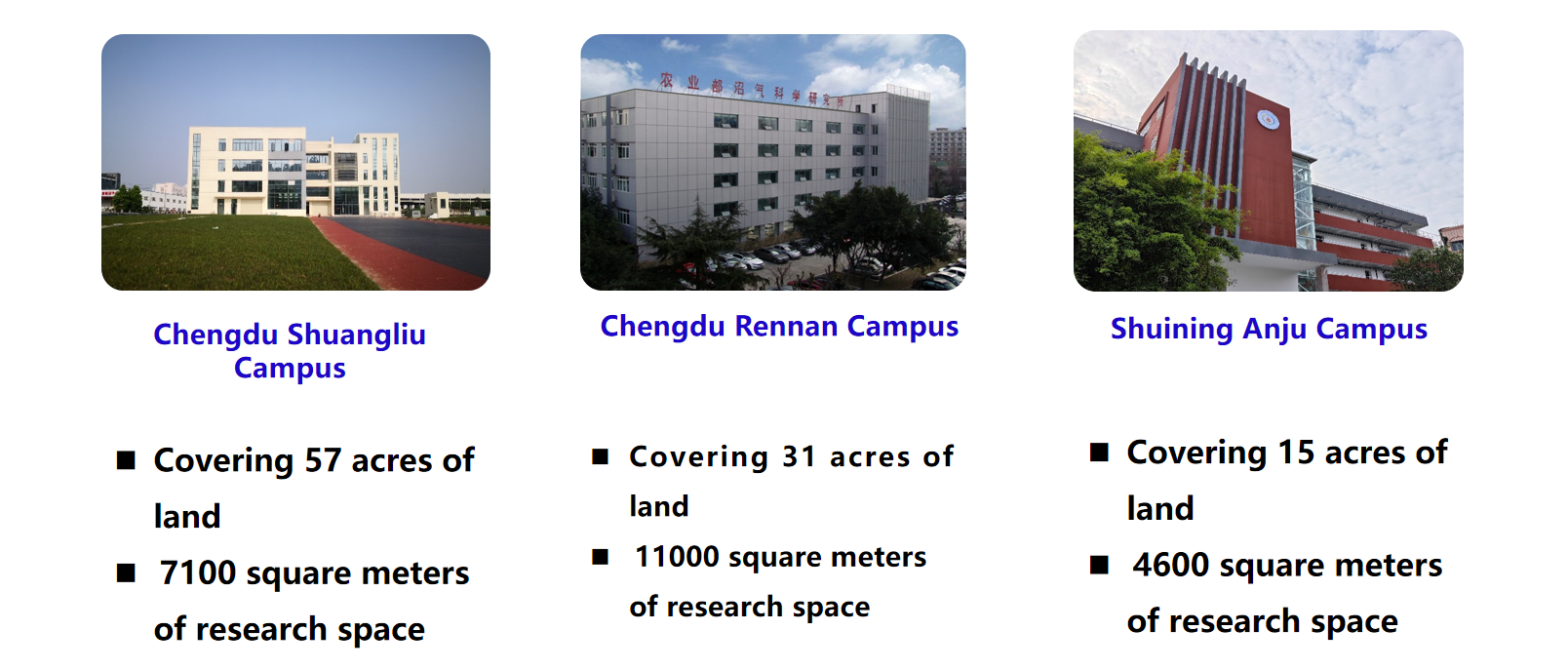
The Institute currently operates four research and office campuses: the Renmin South Road Campus, Shuangliu Campus, Anju Campus, and the Chengdu Center. The Renmin South Road Campus serves as the core for scientific research and administration in traditional strength disciplines such as anaerobic microbiology. The Shuangliu Campus functions as a pilot-scale platform for the incubation and maturation of innovative research outcomes. The Anju Campus serves as a platform for education and cultural heritage related to the rural energy revolution. The Chengdu Center supports the expansion of disciplinary directions in rural clean energy.
The Institute hosts 22 research platforms, including the FAO Biogas Technology Research Center, the International Science and Technology Cooperation Base for Biogas Technology under the Ministry of Science and Technology, and the Key Laboratory of Rural Renewable Energy Development and Utilization of the Ministry of Agriculture and Rural Affairs. In addition, the Institute publishes China Biogas, the most influential academic journal in the field, and operates the China Collection of Anaerobic Microorganisms (CCAM), the most advanced and largest anaerobic microbial culture collection in China.
Human Resources
The Institute currently has 113 authorized staff members, 33 postdoctoral researchers employed by the Institute, 30 contract personnel, and 116 graduate students, totaling 292 personnel. Among the authorized staff, 83 hold postgraduate degrees. There are 22 researchers with senior professional titles and 42 with associate senior titles.
The Institute includes one academician of the Chinese Academy of Engineering, one recipient of the National Science Fund for Distinguished Young Scholars, two experts receiving the State Council Special Government Allowance, one National Middle-aged and Young Expert with Outstanding Contributions, one high-level talent under the National “Hundred, Thousand, and Ten Thousand Talents Project,” two Shennong Talent Program awardees, one National Outstanding Talent in Agricultural Scientific Research, two position scientists under the National Modern Agricultural Industry Technology System, six “Agricultural Science Talents,” two recipients of the CAAS–DBN Talent Award, one Sichuan Outstanding Contribution Expert, three Sichuan Academic and Technical Leaders and two reserve candidates, two leading innovators under the Qingcheng Plan, three Tianfu Science and Technology Elites, two Tianfu Emei Plan talents, three Tianfu Distinguished Experts, one Chengdu Rongpiao Plan Entrepreneurial Leading Talent, one Chengdu Top Talent, one Chengdu Top Talent Reserve Candidate, and two Rongpiao Plan talents.
Scientific Achievements
Focusing on the scientific and strategic needs of rural development and concentrating on rural energy and ecological research, the Institute prioritizes research on biomass energy development, integrated application of rural new and renewable energy technologies, and rural living environment improvement.
The Institute has undertaken and completed more than 110 public-interest research projects, including those under the National High-Tech R&D Program (863 Program), the National Basic Research Program (973 Program), major national science and technology projects, national science and technology support programs, and the National Science Fund for Distinguished Young Scholars. It has obtained more than 350 authorized patents, published over 850 scientific papers, and formulated or revised 60 national, industry, and local standards. The Institute has received four Second Prizes and three Third Prizes of the National Science and Technology Progress Award, as well as numerous provincial and ministerial awards, including eight First Prizes, nine Second Prizes, and sixteen Third Prizes for scientific and technological progress. These achievements have significantly advanced technological development in China’s rural energy sector and established the Institute’s strong influence in the field.
International Cooperation
The Institute has hosted nearly 600 visits from foreign heads of state, government leaders, experts, and scholars. It has conducted academic exchanges and technical cooperation with renewable energy research institutions in more than 80 countries, including Germany, Denmark, South Africa, Argentina, and the Philippines.
The Institute has undertaken more than 200 technical assistance projects commissioned by the Food and Agriculture Organization of the United Nations (FAO), the United Nations Development Programme (UNDP), the United Nations Industrial Development Organization (UNIDO), as well as China’s Ministry of Commerce, Ministry of Science and Technology, and Ministry of Agriculture and Rural Affairs. Participants in these assistance programs include more than 6,500 government officials and technical personnel from over 130 countries, contributing to the international dissemination of biogas and other renewable energy technologies.
(Data updated as of December 2025)