Research
Sufficient Substrate Is the Key Remedy for “Oxygen Toxicity” in Anaerobic Digestion Systems
Recently, the Biogas Institute of Ministry of Agriculture and Rural Affairs Team of Animal Wastes Utilization as Energy and Pollution Control revealed the quantitative impact of oxygen on methane production in anaerobic digestion systems, challenging the traditional assumption that biogas fermentation must be strictly isolated from oxygen. The research findings were published in Chemical Engineering Journal.
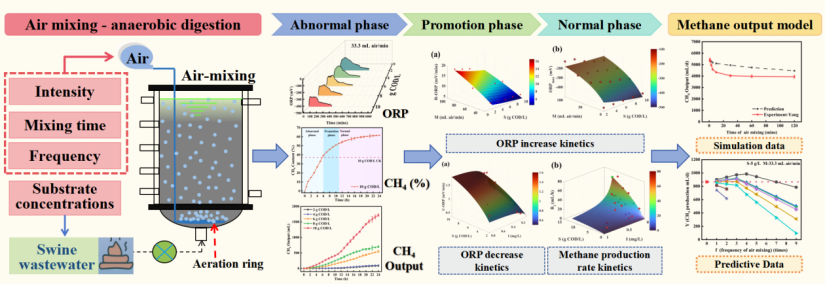
To address the problems associated with conventional anaerobic digestion technologies—such as high energy consumption of mechanical stirring and potential safety risks of biogas-based mixing—the study proposed using air instead of biogas for mixing. The results demonstrated that organic substrate concentration is the key factor enabling the rapid recovery of methane production in the system. By increasing the concentration of organic matter, the system’s oxygen consumption rate was enhanced, accelerating the re-establishment of an anaerobic environment favorable for methane production and thereby improving the system’s resistance to oxygen stress.
In addition, the study developed a comprehensive kinetic modeling framework. Among them, the methane production model can quantitatively predict the total methane yield within 24 hours, with model errors controlled within 15%. Using this model, the optimal mixing intensity and frequency can be directly determined based on substrate concentration.
This research provides important theoretical support for optimizing the operation of large-scale biogas projects.
The study was supported by the China Agriculture Research System and the Sichuan Provincial Science and Technology Program, among other funding programs.
Link to the original article::https://doi.org/10.1016/j.cej.2026.172771