

Research
New Mechanism of Quorum Sensing Signal Regulation of Microalgal Growth and Lipid Accumulation: Insights for Green Microalgal Biomanufacturing
The Innovative Team of Animal Wastes Utilization as Energy and Pollution Control at BIOMA has made new progress in the study of microalgal metabolic regulation. The team discovered that the bacterial quorum sensing signal molecule N-octanoyl-L-homoserine lactone (C8-HSL) can promote the growth and lipid accumulation of Chlorella under non-stress conditions, and proposed a regulatory model in which reactive oxygen species (ROS) are involved in microalgal metabolic reprogramming. The findings have been published in Bioresource Technology.
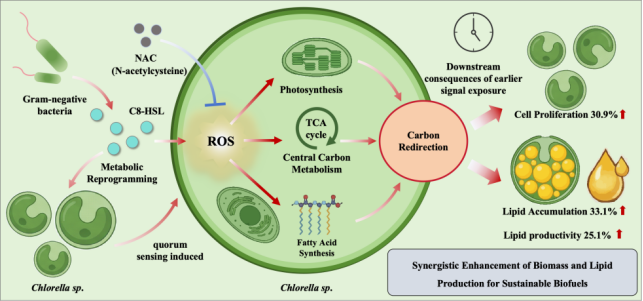
Figure: Schematic diagram of C8-HSL-mediated regulation of microalgal growth and lipid accumulation
To address the long-standing limitation of conventional microalgal lipid enhancement strategies—where lipid accumulation is often accompanied by growth inhibition, thereby constraining overall lipid productivity—this study introduced the bacterial quorum sensing signal molecule C8-HSL into Chlorella cultures and conducted systematic physiological, biochemical, and transcriptomic analyses.
The results showed that treatment with an appropriate concentration of C8-HSL significantly promoted cell proliferation and lipid biosynthesis in Chlorella. Cell density, neutral lipid content, and lipid productivity increased by 30.9%, 33.1%, and 25.1%, respectively. Further analysis indicated that C8-HSL induced moderate ROS accumulation and activated antioxidant defense responses, accompanied by the coordinated upregulation of genes involved in photosynthesis, carbon fixation, acetyl-CoA generation, and fatty acid biosynthesis pathways.
Integrating physiological measurements, transcriptomic data, and antioxidant intervention experiments, the research team proposed that C8-HSL may promote the redistribution of intracellular carbon flux toward lipid biosynthesis through ROS-mediated metabolic regulation, thereby enabling the simultaneous enhancement of both microalgal growth and lipid accumulation.
This study provides new experimental evidence for understanding algae–bacteria signal interactions in regulating microalgal carbon allocation. It also offers a novel strategy for precisely controlling microalgal biomass and lipid production using quorum sensing signals, contributing new insights for the development of algae-based metabolic regulation and green biomanufacturing technologies.
This research was supported by the National Natural Science Foundation of China, the Agricultural Science and Technology Innovation Program of the Chinese Academy of Agricultural Sciences, and the Sichuan Provincial Science and Technology Program.
Article:https://www.sciencedirect.com/science/article/abs/pii/S0960852426012708?via%3Dihub