Research
Waste Bamboo Converted into Biochar with Ultra-Low Specific Surface Area for Highly Efficient Antibiotic Adsorption
The Biomass Thermochemical Conversion and New Energy Integration Team has successfully turned waste bamboo into a novel environmentally friendly material capable of efficiently removing antibiotics from water, effectively transforming waste into value-added resources. The related findings were published in Bioresource Technology.
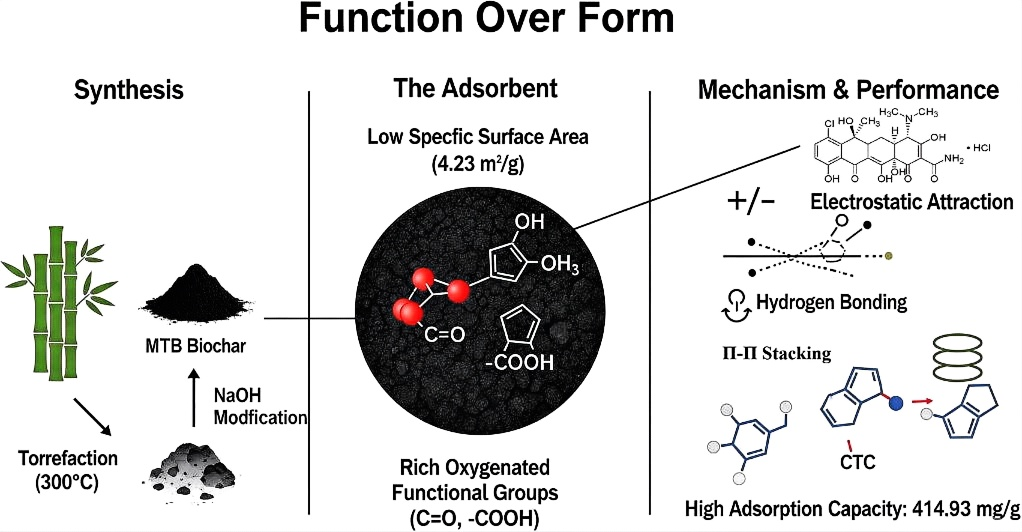
Conventional water purification materials often rely on complex porous structures and high-temperature processing, which lead to high costs and significant energy consumption. Taking a different approach, the research team proposed a new concept: “function is more important than structure.” In this study, bamboo was first torrefied at relatively low temperatures to form a stable carbon skeleton. Subsequently, the material surface was modified using a mild alkaline treatment, which precisely introduced functional chemical groups capable of capturing antibiotic molecules.
The resulting biochar appears to have very limited porosity (with a specific surface area of only 4.23 m²/g), yet it demonstrates remarkably strong adsorption capacity for the common antibiotic chlortetracycline hydrochloride, with adsorption efficiency even surpassing that of advanced materials such as graphene.
This research challenges the traditional notion that high porosity is a prerequisite for high adsorption performance, and for the first time achieves independent regulation of material structure and function. With low energy consumption and a simple preparation process, the technology not only provides a cost-effective solution for antibiotic contamination control in water systems, but also creates a high-value application pathway for waste bamboo, promoting the green recycling and utilization of agricultural residues.
This work was supported by the Chinese Academy of Agricultural Sciences Youth Innovation Program, among other funding projects.
Link to the original article::https://doi.org/10.1016/j.biortech.2025.133790