Research
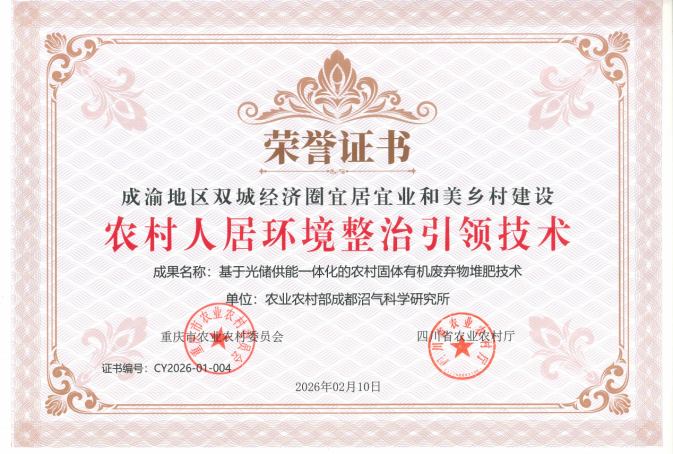
The technological achievement of the Team of Pollution Treatment of Rural Living Environments at the Biogas Institute of Ministry of Agriculture and Rural Affairs (BIOMA) has been selected as a Leading Technology for the Development of Livable, Business-Friendly, and Harmonious Villages in the Chengdu–Chongqing Region.
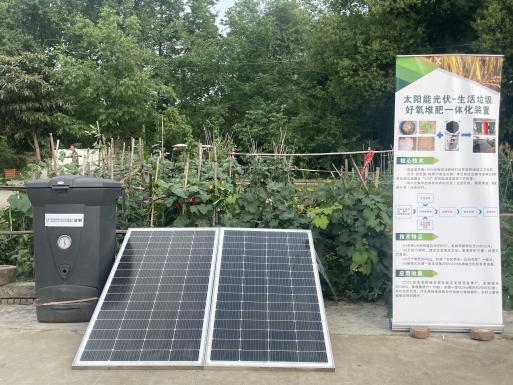
To implement the guiding principles of the Fourth Plenary Session of the 20th CPC Central Committee, promote the development of livable, business-friendly, and harmonious villages, and comprehensively enhance rural living environment governance in the Chengdu–Chongqing region, the Chongqing Municipal Commission of Agriculture and Rural Affairs and the Sichuan Provincial Department of Agriculture and Rural Affairs jointly organized a call for leading technologies and typical cases for rural revitalization in the Chengdu–Chongqing Economic Circle. The selection results have recently been released. The technology titled “Composting Technology for Rural Solid Organic Waste Based on Integrated Photovoltaic and Energy Storage Power Supply”, developed by the Team of Pollution Treatment of Rural Living Environments at BIOMA, has been recognized as a leading technology for rural living environment improvement.
This selection aims to address key environmental governance challenges in rural development across the Chengdu–Chongqing region, identify replicable and scalable appropriate technologies, and support the construction of harmonious villages. The selected technology from BIOMA focuses on key challenges in rural solid organic waste treatment. By integrating a photovoltaic-plus-energy-storage power supply system, it enables aerobic composting processes to operate independently of extreme temperature conditions, providing a rapid and clean pathway for converting rural organic waste. It supports decentralized, small-scale ecological circular agriculture models in rural areas. Meanwhile, the fertilizer products generated by this technology enhance soil activity, reduce the application of chemical fertilizers, gradually restore soil ecological structure, and mitigate carbon and ammonia emissions as well as non-point source pollution caused by agricultural waste burning and manure discharge, thereby improving rural living environments.
A total of 6 leading technologies for rural living environment improvement, 10 typical cases of long-term management mechanisms, 3 typical cases of rural sanitary toilet construction and management, and 10 typical cases of village appearance enhancement were selected in this initiative.