Research
A New Regulatory Strategy for Efficient Low-Temperature Nitrogen Removal by Anammox Bacteria — Enabling High-Efficiency, Low-Energy Treatment of Livestock Biogas Slurry in Winter
Recently, the Biogas Institute of Ministry of Agriculture and Rural Affairs Team of Animal Wastes Utilization as Energy and Pollution Control achieved significant progress in understanding the mechanism of stable low-temperature operation of the Autotrophic Nitrogen Removal (ANR) process. The study revealed the molecular mechanism by which anammox bacteria adapt to low temperatures through metabolic pathway reconstruction and identified low sludge concentration as a key bottleneck limiting system performance. These findings provide an important theoretical foundation for the efficient and low-energy nitrogen removal treatment of livestock biogas slurry during winter. The results were published in Chemical Engineering Journal.
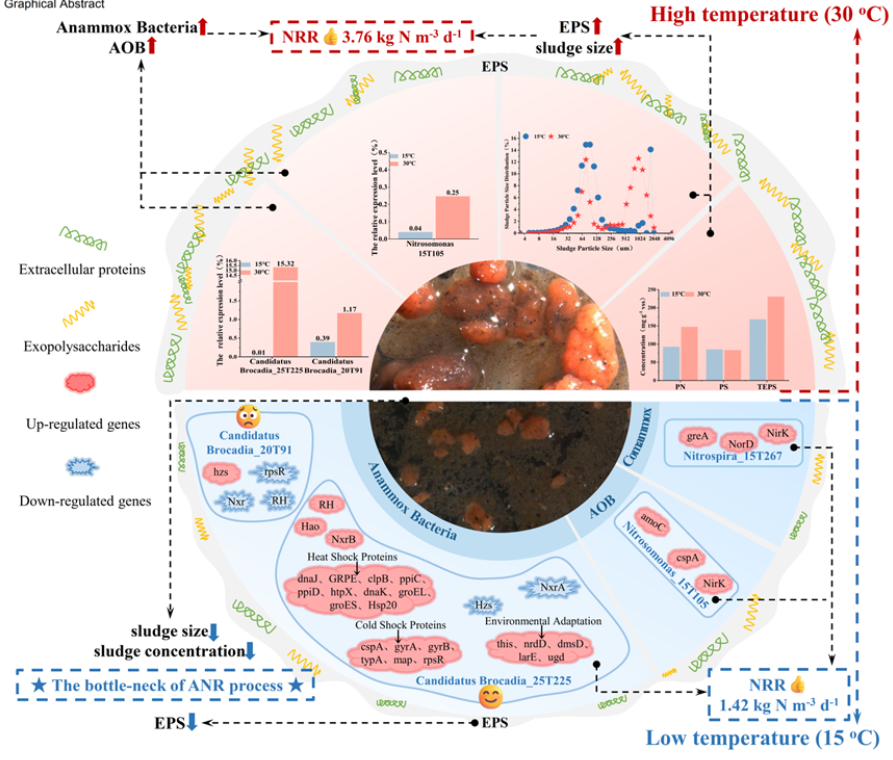
The autotrophic nitrogen removal process is a cost-effective, environmentally friendly biological nitrogen removal technology for wastewater, with broad application prospects. However, its widespread application in water pollution control has been severely constrained because its core functional microorganisms—anammox bacteria—are highly sensitive to low temperatures.
In this study, metagenomic and metatranscriptomic analyses showed that after 400 days of operation at 15 °C, a cold-adapted anammox bacterium was successfully enriched and became the dominant species, accounting for 75% of the anammox bacterial population in the system. This strain adapted to low temperatures by upregulating genes related to cold adaptation, weakening the mainstream anammox metabolic pathway while enhancing dissimilatory nitrate reduction and denitrification side pathways, thereby increasing overall nitrogen metabolic activity and maintaining relatively high activity under low-temperature conditions.
Meanwhile, ammonia-oxidizing bacteria and complete nitrifiers responded synergistically to the low-temperature environment by upregulating genes associated with ammonia oxidation and stress response, compensating for part of the activity loss of anammox bacteria.
This research provides important theoretical support and technical guidance for low-energy treatment of livestock biogas slurry in cold regions and during winter seasons.
The study was supported by the National Natural Science Foundation of China, the Chinese Academy of Agricultural Sciences Youth Innovation Program, the Chinese Academy of Agricultural Sciences Science and Technology Innovation Program, and the Sichuan Provincial Science and Technology Program.
Link to the original article::https://www.sciencedirect.com/science/article/pii/S1385894726011691#f0030