Research
Oxidative Pyrolysis Technology: Lanthanum “Consumes” Carbon Emissions While Forming Functional Materials
The Straw Resource Utilization Innovation Team has developed a lanthanum-based oxidative pyrolysis carbon capture technology, successfully preparing a biochar-supported lanthanum carbonate composite antibacterial adsorbent, thereby coupling carbon capture with functional composite material synthesis. The research findings were published in Sustainable Materials and Technologies.
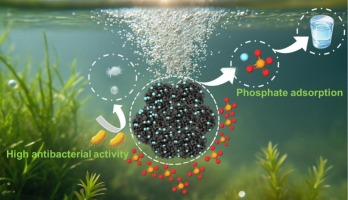
Addressing the critical challenge of removing phosphates and pathogenic microorganisms (such as E. coli and S. aureus) from aquatic environments, this study developed a lanthanum-based oxidative pyrolysis carbon capture technology and successfully fabricated a biochar-supported lanthanum carbonate composite antibacterial adsorbent. The results showed that during the oxidative pyrolysis process, CO₂ generated in situ can be captured by lanthanum, forming La₂O₂CO₃ crystals on the surface of biochar.
The resulting composite material exhibited excellent adsorption performance, achieving a phosphate adsorption capacity of up to 135 mg/g at a dosage of 0.1 g/L. In addition, the material demonstrated remarkable dual functionality: while achieving >99.99% inactivation of S. aureus and E. coli, its phosphate adsorption capacity remained unaffected. This synergistic nutrient capture–disinfection dual function provides a single-step solution for two major challenges in water treatment—eutrophication control and pathogen elimination. The study offers a new strategy for developing high-efficiency biochar-supported antibacterial phosphate adsorbent materials.
Yang Lijun and Shen Yiyi, master’s students enrolled in 2022, are co-first authors, and Researcher Dai Lichun is the corresponding author.
This research was supported by the National Natural Science Foundation of China (22578234), the China Agriculture Research System Sichuan Innovation Team Post Expert Program (SCCXTD-2024-12), and the Chinese Academy of Agricultural Sciences Agricultural Science and Technology Innovation Program (CAAS-ASTIP-2021-BIOMA), among other funding sources.
Link to the original article::https://doi.org/10.1016/j.susmat.2026.e01896