

Research
New Application Model Proposed for Bacterial 3D Genomics
Recently, the Innovation Team of Microbial Synthetic Biology and Biotransformation at the Biogas Institute of Ministry of Agriculture and Rural Affairs revealed the hierarchical folding principles of bacterial chromosomes and proposed potential applications of bacterial three-dimensional (3D) genomics in synthetic biology and antibacterial strategies. The related findings were published in Genome Biology.
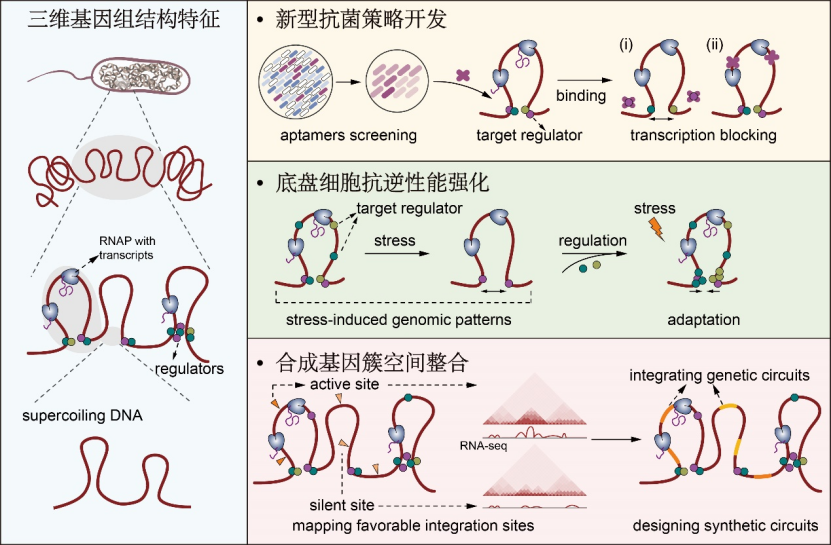
Bacterial chromosomes are not randomly organized; instead, they fold into specific three-dimensional spatial conformations that directly regulate bacterial growth, reproduction, and responses to environmental stresses. However, how bacterial DNA sequences are progressively assembled into the spatial architecture of a complete chromosome, and how gene transcription dynamically regulates these structural changes, has remained an unresolved question in the field.
The research team discovered that activated gene expression can induce local chromosomal conformational changes, forming transcription-driven active units. The chromosome exhibits a multilayered spatial organization, ranging from small transcriptional active units to larger interaction domains. Under stress conditions, transcriptional activity serves as the core driving force for chromosomal structure remodeling, while specific proteins play critical roles in maintaining genome stability.
Based on these findings, the study proposed several application strategies for bacterial 3D genomics. Relevant proteins could serve as novel antibacterial drug targets, while genetic engineering approaches may enhance the tolerance of industrial microorganisms to stresses such as acidity, alkalinity, and high temperature, thereby improving the stability of fermentation processes. In addition, transcriptionally active regions associated with high-frequency chromosomal interactions were identified as preferred sites for foreign gene integration, which could optimize the expression efficiency of synthetic genetic circuits. These findings provide theoretical support for the construction of highly efficient microbial chassis cells for biomanufacturing and the development of new antibacterial technologies.
This research was supported by the National Natural Science Foundation of China, the Sichuan Science and Technology Program, and the Agricultural Science and Technology Innovation Program of the Chinese Academy of Agricultural Sciences.
Original article: https://doi.org/10.1186/s13059-026-04117-8