Research
Efficient Conversion of Wasted Cooking Oil into Clean Fuels over Novel RuFe Catalyst
Recently, researchers from the High-Quality Biomass Fuels Team at the Biogas Institute of the Ministry of Agriculture and Rural Affairs (Chengdu, China) have developed a novel RuFe bimetallic catalyst that enables the upgrading of waste cooking oil into directly usable automotive fuels, achieving a carbon atom utilization efficiency of up to 94.7%. The related research findings have been published in Industrial Crops & Products.
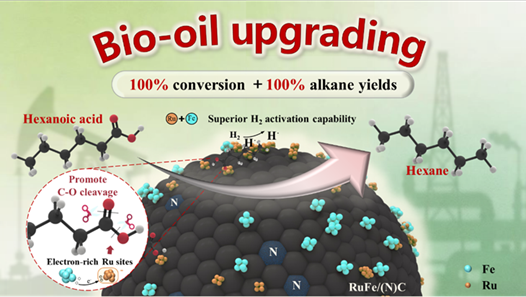
In the conventional catalytic upgrading of waste cooking oil to alkane fuels, traditional technologies often face two major bottlenecks: first, the reliance on expensive noble metals, which results in prohibitively high costs; and second, the substantial loss of carbon atoms in the form of CO₂ or CO during the conversion process, leading to low carbon utilization efficiency and poor alkane product yields. In collaboration with research teams from Sichuan University and the Polytechnic University of Valencia (Spain), the scientists at the Biogas Institute developed a ruthenium iron bimetallic catalyst supported on nitrogen doped graphene (0.5Ru10Fe/(N)C). This catalyst enables complete conversion of fatty acids present in waste cooking oil under mild conditions (T = 240 °C, P = 1 MPa), achieving a total alkane yield close to 100% and a carbon efficiency as high as 94.7%, meaning that nearly all carbon atoms are retained in the liquid fuel products. Through systematic characterization, the experiments revealed that the outstanding catalytic performance originates from the synergistic effect between Ru and Fe, which enhances the catalyst's ability to adsorb and activate hydrogen. Meanwhile, the electron rich Ru sites enable highly selective cleavage of C−O bonds, thereby improving the yield of long chain alkanes. Kinetic studies further demonstrated that the hydrogenation of fatty acids to fatty alcohols is the rate determining step of the overall reaction. The as prepared bimetallic catalyst exhibits a significantly lower activation energy (76.1 kJ/mol) than monometallic Ru (90.3 kJ/mol) and monometallic Fe (101.7 kJ/mol), and shows a remarkable intrinsic activity advantage (TOF up to 369.6 h⁻¹).
This study replaces the high cost Pt and Pd systems with a combination of relatively inexpensive Ru (among noble metals) and cheap Fe, achieving a highly selective hydrodeoxygenation pathway under mild conditions while substantially reducing carbon loss. It provides an economically viable new route for upgrading low value biomass oils into high quality biofuels, and holds promise for turning kitchen waste oils and agricultural/forestry residues into truly "mobile alternative oilfields," offering solid technical support for replacing fossil fuels with renewable energy sources.
Dr. Yang Huiru from the High Quality Biomass Fuels Team is the first author of the paper. This research was supported by the Major Tasks of the Chinese Academy of Agricultural Sciences, the National Natural Science Foundation of China, and other funding programs.
Original link: https://www.sciencedirect.com/science/article/pii/S0926669026012963?via%3Dihub