

Research
Pore-Confined, Small-Sized Ni/Zeolite Catalysts Enable the Conversion of Agricultural and Forestry Waste into Sustainable Aviation Fuel Components
Researchers from the Biogas Science Research Institute of the Ministry of Agriculture and Rural Affairs (BIOMA) and Southeast University (SEU) have reported new progress in the high-value utilization of agricultural and forestry waste, including straw and wood chips. By regulating the size of nickel nanoparticles and harnessing the confinement effect of zeolite micropores, the research team achieved the efficient conversion of lignin into aromatic hydrocarbons, a key component of sustainable aviation fuel (SAF), with a selectivity of 60.5%. The findings were published in ACS Catalysis.
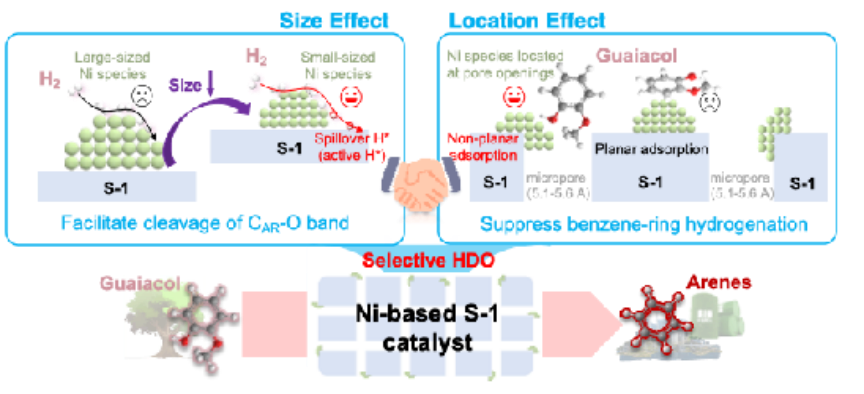
Lignin is an abundant renewable aromatic polymer found in agricultural and forestry residues such as straw and wood chips. Its valorization, however, remains challenging because of its high oxygen content and complex chemical structure. Although nickel-based catalysts are attractive due to their low cost and high catalytic activity, they often promote excessive hydrogenation, leading to the loss of valuable aromatic structures. In this study, the researchers controlled the nickel particle size at ~9 nm and strategically positioned the particles near the entrances of zeolite micropores. This structural design enabled the micropore confinement effect to regulate the reaction pathway, facilitating oxygen removal while suppressing the over-hydrogenation of aromatic rings. As a result, the yield and selectivity of the desired aromatic products were significantly improved. The study provides new insights into the relationship between metal particle size, spatial distribution, and catalytic performance. It also offers a theoretical basis and a practical strategy for developing highly efficient catalysts for the conversion of lignin into aromatic hydrocarbons and SAF components.
The study was led by corresponding authors Dr. Wen Chengyan (BIOMA) and Prof. Zhang Xinghua (SEU). The research was supported by the National Key Research and Development Program of China, the National Natural Science Foundation of China, the Agricultural Science and Technology Innovation Project of Chinese Academy of Agricultural Sciences, and the Key Technology Research and Development Project of Sichuan Provincial Department of Agriculture and Rural Affairs.
Original link: https://pubs.acs.org/doi/10.1021/acscatal.6c01000