

Research
Researchers identify the sixth methanogenic pathway
Researchers have identified the sixth methanogenic pathway by isolating a pure culture of an archaeon capable of converting medium- and long-chain fatty acids directly to methane. The study was conducted by the Center for Frontier and Interdisciplinary Research in Anaerobic Microbiology, jointly established by the Biogas Institute of Ministry of Agriculture and Rural Affairs (BIOMA) and the Agricultural Genomics Institute at Shenzhen, Chinese Academy of Agricultural Sciences (AGIS-CAAS). The findings were published in Nature on 21 October 2026.

Methane is the major component of biogas and natural gas. In anaerobic environments, the conversion of complex organic compounds to methane has traditionally been understood as a syntrophic process involving different groups of microorganisms. In this classical model, bacteria degrade complex organic matter into smaller intermediates, such as H2/CO2 and acetate, which are then utilized by methanogens to produce methane.
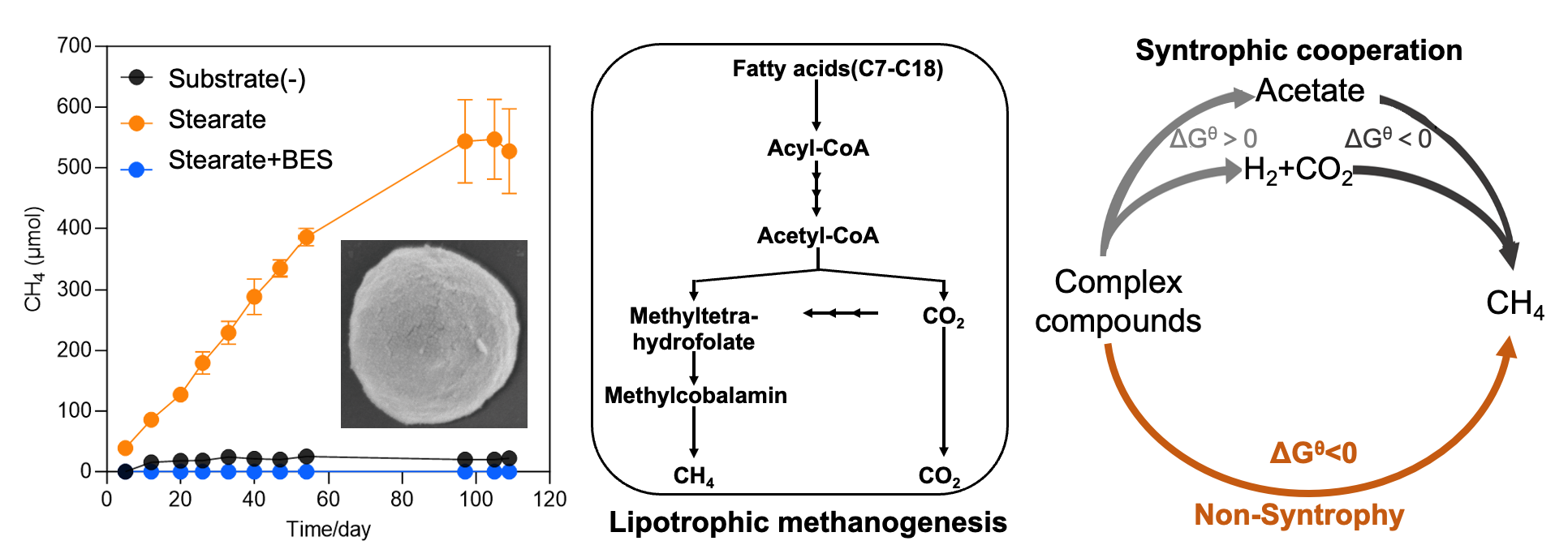
Thermodynamic predictions, metagenomic studies and enrichment cultivation have suggested that some microorganisms may be able to couple the degradation of complex organic compounds directly to methanogenesis. However, direct physiological evidence from a pure culture was lacking.
To address this question, the research team developed a targeted isolation strategy for slow-growing anaerobic microorganisms based on exploiting their relative growth advantages, together with a “cocktail” cultivation approach. Using this strategy, they isolated a new archaeal species, Methanoglobus dolicholipophagus AA-75. Physiological characterization showed that AA-75 can directly convert a range of medium- and long-chain fatty acids to methane. The researchers term this metabolism lipotrophic methanogenesis, and propose it as the sixth methanogenic pathway, following the previously recognized aceticlastic, hydrogenotrophic, methylotrophic, methoxydotrophic and alkylotrophic pathways.
The discovery of AA-75 provides the first pure culture evidence that methanogens are capable of methanogenic degradation of complex compounds. It challenges the long-standing paradigm that the conversion of complex organic matter to methane requires syntrophic cooperation between bacteria and methanogens. The finding expands the known metabolic repertoire of methanogens and provides new insight into the global carbon cycle. It also provides a promising chassis microorganism for the development of single-cell-based biotechnology to generate high-value-added products from distinct types of organic waste.
Looking ahead, the research team will pursue end-to-end research on anaerobic microbial resource discovery and biomanufacturing, accelerate the development of model-organism repositories and major research platforms for anaerobic microbiology, and strengthen the integration of resource discovery, fundamental scientific breakthroughs and disruptive technological innovation. The team will also promote cross-disciplinary collaboration among anaerobic biomanufacturing, synthetic biology and artificial intelligence, with the aim of supporting emerging industries in bio-agriculture, future foods, new energy, biomedicine and advanced materials, and fostering new quality productive forces.
The study was supported by the National Natural Science Foundation of China, the Chinese Academy of Agricultural Sciences, and the Sichuan Science and Technology Program.
Paper Link: https://www.nature.com/articles/s41586-026-11207-x